Car keys · Toronto
Car Key Replacement
The fob went through the washing machine in a jacket pocket.
In plain words
Older vehicles without an immobilizer are a pleasure to key, but whether a given car has one is checked rather than assumed from age, since several early-2000s vehicles already shipped with a factory immobilizer. Where a car genuinely needs only a blade, it is cut to the factory code or to a reading of the lock rather than copied from a worn original, so it seats cleanly in an ignition that has seen twenty winters. Where the ignition wafers are tired, the locksmith can say so and service the cylinder in the same visit. The result is a key that turns like the car was new, without the daily jiggle.
How the visit goesThe only key to the car went into the lake with the kayak. Now the car sits locked in the driveway with a full tank, and there is no spare in the house, in a coat pocket or anywhere else.
Car Key Replacement
How the visit goes
Parts and data lined up before the tools come out
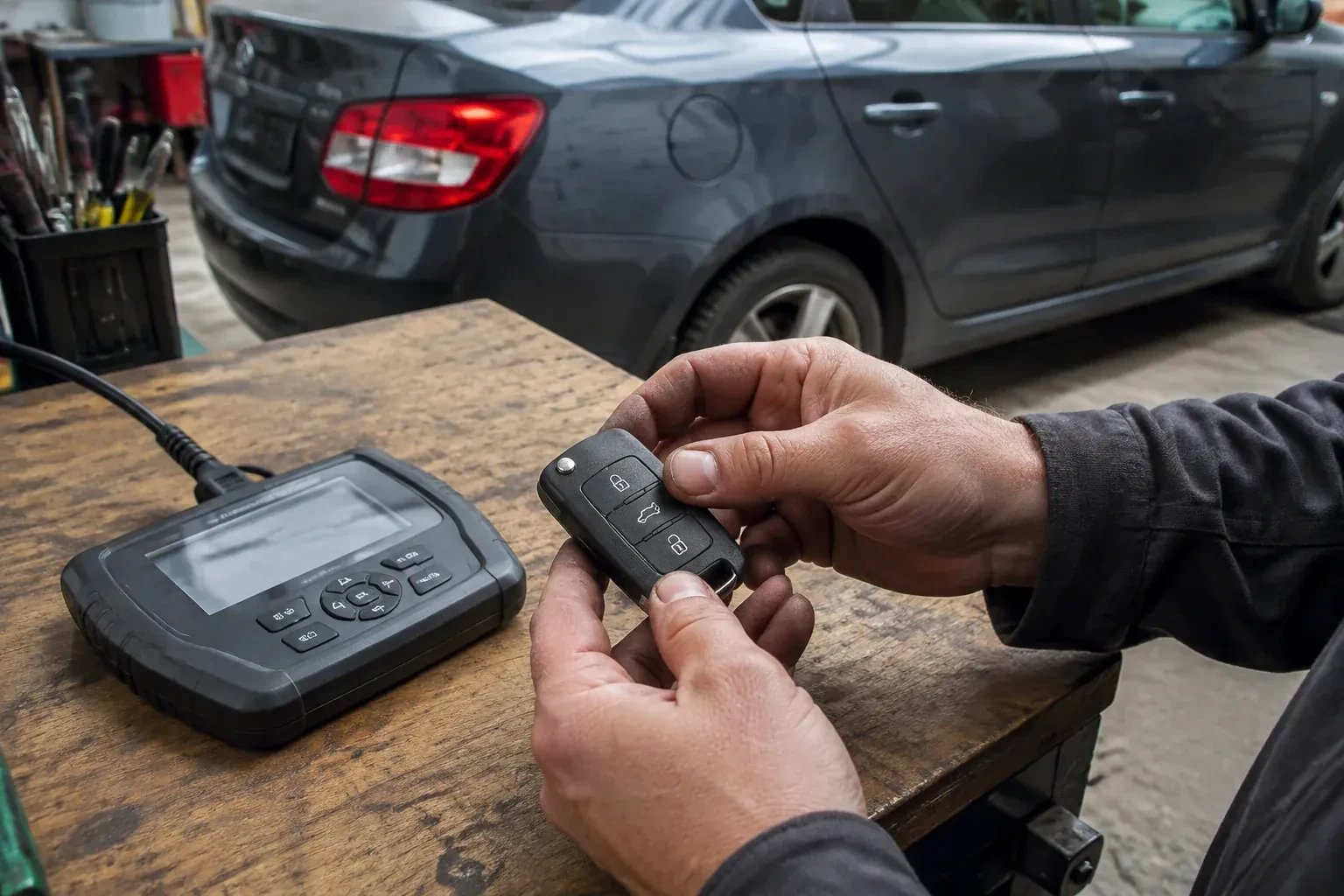
Some vehicles hand over their security data readily; others require a PIN pulled from the car, a code from the manufacturer, or a procedure only the dealer's tooling can run. The locksmith confirms which applies to your VIN before committing to a key, and confirms the part is available: fobs are specific to frequency, part number and sometimes trim level, and a wrong one programs and then refuses to work the doors. For the systems that use manufacturer secure data, access is arranged through the industry's Vehicle Security Professional registry, which is why the ownership record is completed properly first. Nothing is cut until this line-up is clear.
Milling a high-security blade
Many vehicles from the last two decades use an internal-cut key, sometimes called a laser-cut or sidewinder key, with a wavy groove milled into the flat of the blade instead of teeth along its edge. These are produced on a milling cutter that follows the code to a fine tolerance, because the wafers in a high-security lock have little forgiveness for an off-depth cut. The blank is clamped, the groove is milled on both sides, the burrs are cleaned off and the blade is checked in the lock for smooth travel. A blade that drags or catches is recut rather than forced.
A spare, and the reason to keep it away from the car
Two working keys change the shape of every future visit. With one in hand, adding another is a short programming routine; with none, the car has to be opened, decoded and reset. For that reason the locksmith will usually suggest making the spare while the tools are out, and will suggest a home for it that is not the glovebox, the console or a magnetic box under the bumper. A drawer at home, a trusted family member or a small lockbox all work. Test the spare every few months so a flat coin cell is discovered on a Sunday afternoon rather than in a parking lot.
Car Key Replacement
In the van
Vehicle battery maintainer
Remote frequency tester
Transponder key blank
OBD programming tool
Transponder chip
Car Key Replacement
What affects the quote
Condition of the locks and ignition
A door cylinder seized with salt or an ignition with worn wafers may need freeing, servicing or rebuilding for the new key to feel right. That work is quoted as its own item alongside the key.
Original or aftermarket part
A manufacturer fob and a good aftermarket equivalent both do the job on many models, at different part costs. The locksmith says which is proposed for your car and why, and the quote names the part.
Erasing the keys you no longer hold
Removing lost or stolen keys from the immobilizer during the session is a small extra step, and re-registering the keys you kept follows it. If you want the old keys silenced, say so and it is quoted.
What to have ready
- What is the year, make and model, and can you read the VIN from the windshield or the permit?
- Would you like any missing keys erased so they can no longer start the car?
- Do you have any key that still starts the car, or are they all gone?
Car Key Replacement: questions
QuestionsDo you use original manufacturer fobs or aftermarket ones?
Both exist, and the locksmith will say which is proposed for your car. Original parts match the vehicle exactly and are the safer choice for the newest systems and for features like remote start or phone pairing. Well-made aftermarket keys and fobs are widely used on common models and suit spares and older vehicles. What matters in every case is the correct frequency, part number and chip type, which the VIN confirms.
How long should I allow for the visit?
It depends on the starting point. Adding a spare to a car with a working key is often the shortest kind of visit. An all-keys-lost job on a newer vehicle takes longer, because the car has to be opened, the lock decoded, the immobilizer reset and any security timer waited out. Milling a high-security blade and pairing a proximity fob add their own steps. The locksmith gives you a realistic window once the VIN and the situation are known.
Can you make a key if every key to the car is gone?
Often, yes, for vehicles with a supported conventional key system: the car is opened, a blade is produced by decoding the door lock or retrieving the factory key code, and the immobilizer is reset so the missing keys are erased before new ones are stored. A key-card or phone-key vehicle, or one needing a dealer procedure, follows its own route instead, which is why the VIN is asked for on the first call.
Related services
- Spare Car Key DuplicationThe paperwork for the used car changed hands last week, and the previous owner mentioned, almost as an afterthought, that a second key never turned up.
- Key Fob ProgrammingThe remote clicks the way it always has, but the vehicle no longer locks, unlocks or answers with its usual chirp.
- Transponder Key ProgrammingThe new key slides into the ignition and turns exactly the way the old one did, but the engine only cranks.